Impact and Knowledge Transfer
As enabling sciences, mathematics and statistics have both a significant challenge and a powerful opportunity when it comes to impact and knowledge transfer. The challenge is that the pathway between a mathematical or statistical result and its use in a product, procedure or regulation that changes society is often long and indirect. The opportunity is that a given mathematical or statistical result often has the potential to find application in a wide range of different areas of application.
The end-users of research outputs from mathematics and statistics are often applied researchers working within government and industry. They are constantly in need of research that informs better practice, helps to solve problems, and introduces new ways to address issues associated with the exponential growth of data and populations.
ACEMS provides a formal pathway from its four research themes, Challenging Data, Multiscale Models, Enabling Algorithms and Informed Decisions to applications in its Collaborative Domains, Healthy People, Sustainable Environments and Prosperous Societies. Many of ACEMS' Partner Organisations and Industry Affiliates work in these Collaborative Domains and there is a two-way interaction between the partner or affiliate organisation and ACEMS researchers, where the former's high-level concerns motivate research questions addressed by the latter. The outputs of the research then inform the understanding of decision makers in the partner or affiliate organisation. By-products of the interaction, such as standard academic outputs in terms of research papers and presentations, often occur as a bonus.
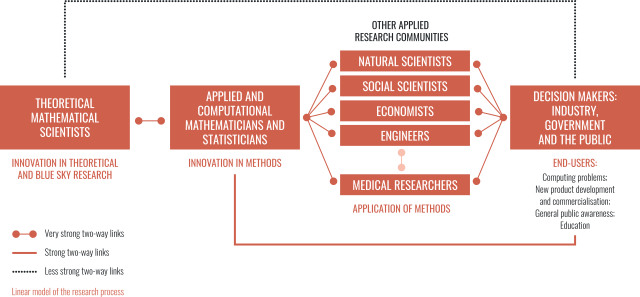
In the mathematical sciences more generally, impact and knowledge transfer can be thought of in terms of the Pathways to Impact Pipeline (see figure). Within this pipeline, there are two mechanisms by which outputs contribute to moving technology towards the marketplace. This can occur through direct development of new technologies that can be used by a 'market' (for example, the development of new R packages and statistical methods), or it can occur through the provision of technical solutions that aid the development of technologies in industry (such as, the optimisation of fuel cell design, or better understanding of distribution and testing methods). New mathematics can be used in ways that efficiently achieve solutions to complicated problems, and new statistical methods can be developed to monitor performance and efficiency.
Research at ACEMS provides new models that help stakeholders better understand their systems and make better decisions. ACEMS research continues to push the frontiers for new and innovative processes with the intention of laying the groundwork for changes in the way society and people interact.
In 2018 the Centre sought to facilitate impact and knowledge transfer through several mechanisms, including: by dedicating the first afternoon at the Annual Retreat to talks describing various aspects of industry interaction or posing problems of interest to industry, by hosting the 'Measuring Impact in the Mathematical Sciences' workshop and through the establishment of the Industry Collaboration Support Scheme (ICSS).
The Industry Afternoon at the Annual Retreat
ACEMS hosted a range of our industry partners and affiliate members and asked them to present on ways in which they believed the expertise of ACEMS can help them achieve their goals. Attendees heard from representatives from VicRoads, the Bureau of Meteorology, Biarri, CSIRO, Cancer Council Queensland, the Red Cross Blood Service, Australian Institute of Marine Science, the Australian Bureau of Statistics and the Defence Science and Technology Group. It was not only an opportunity for ACEMS to hear from these stakeholders, but it was also an opportunity to brainstorm and form new collaborations through a specially focussed workshop. This opportunity generated a number of new ways in which ACEMS' expertise will have real and lasting impact on health, society and the environment.
Measuring Impact Workshop
In April 2018 ACEMS hosted a one day seminar on Measuring Impact in the Mathematical Sciences. This was the second such workshop held by ACEMS, and there are plans to continue and expand its focus in 2019. The workshop brought together key stakeholders in the mathematics community to identify challenges for Measuring Impact in the mathematical sciences and look at new ways to understand how this is achieved. Targeted at mathematics and statistics researchers, participants explored common challenges in measuring research impact and engaging end-users specific to these disciplines. The group investigated practical approaches to measuring impact, by providing case studies, and explored 'next steps' for the discipline. Through a range of invited speakers, the seminar looked at current approaches and challenges to measuring impact, case studies, insights from experts, trends as well as a presentation from the ARC about the future of research impact and engagement within the ARC funding landscape. This seminar was attended by over 30 participants and streamed to all ACEMS nodes. Presentations from the seminar can be seen on the ACEMS Github page.
Industry Collaboration Support Scheme
You can read more about our Industry Collaboration Support Scheme and related initiatives to encourage and support collaboration here.
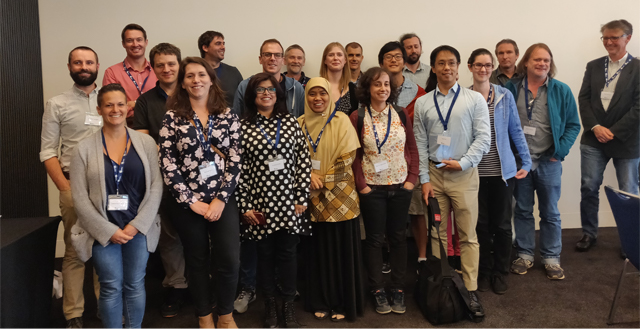
2018 ACEMS Retreat Industry Open Problem Session group shot